HomeStoriesThe EdgeWeaponsBattlesPeopleWarbirdsAbout
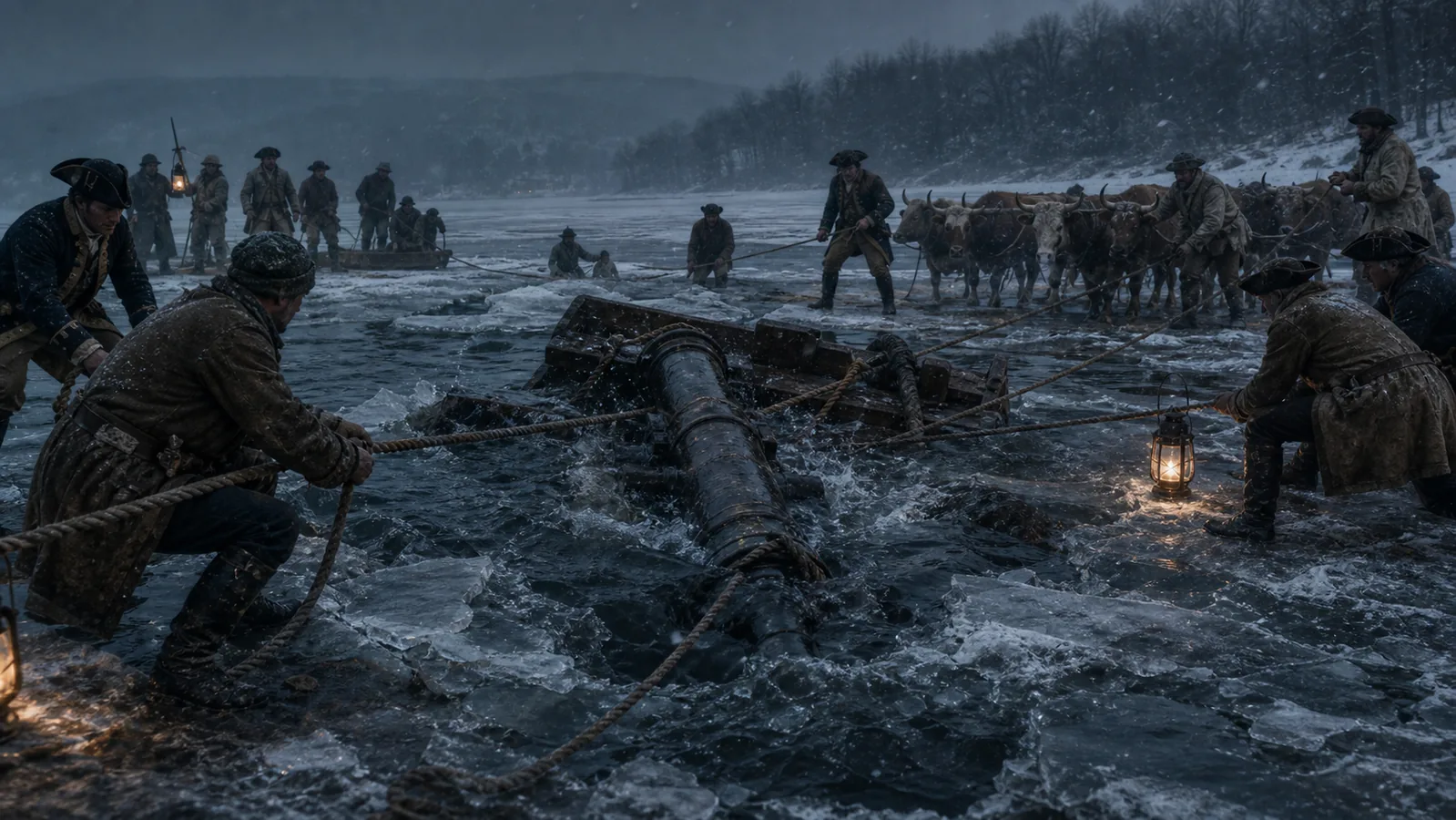
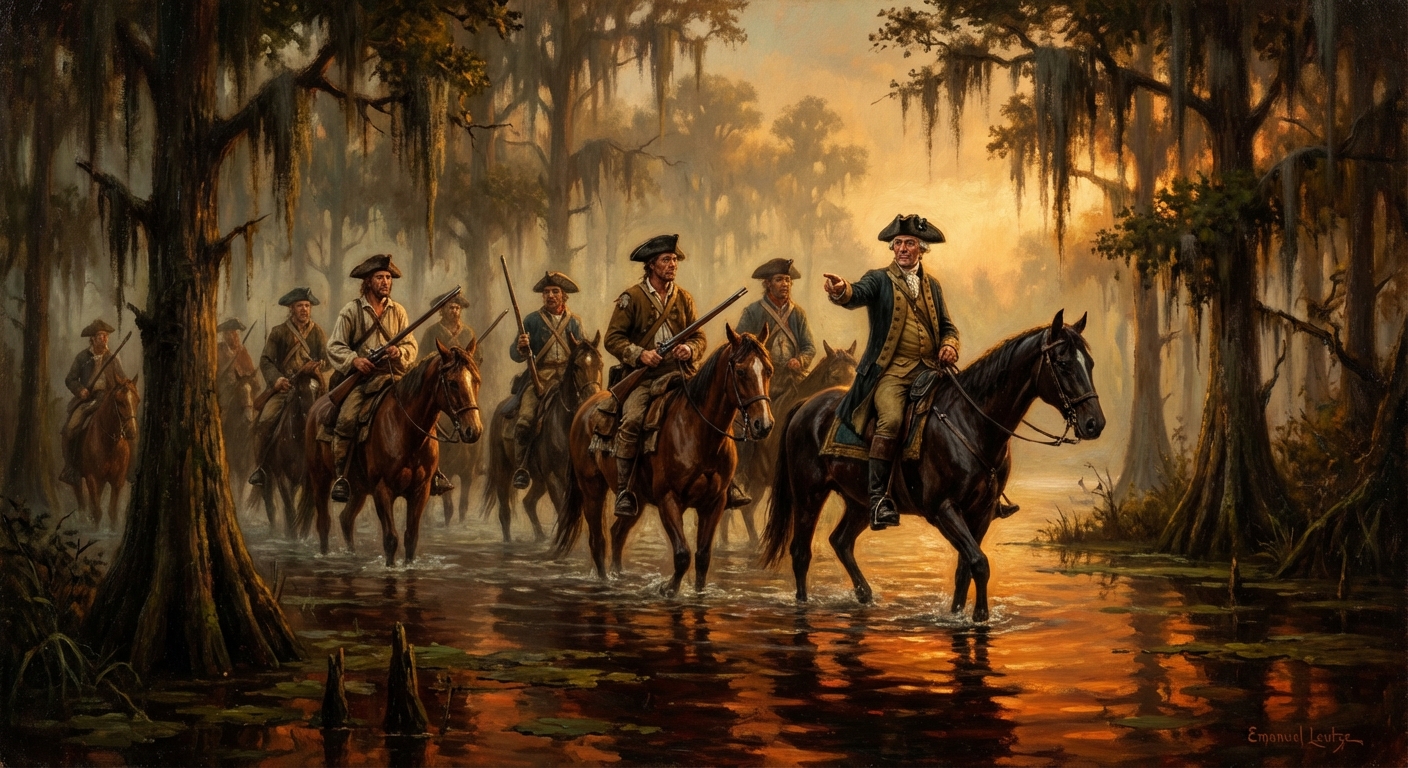
Henry Knox directing the recovery of artillery from a foundering Lake George scow
← Revolutionary War Stories

Fort Ticonderoga / Crown Point to Cambridge - Winter 1775-1776

Henry Knox and the Noble Train of Artillery

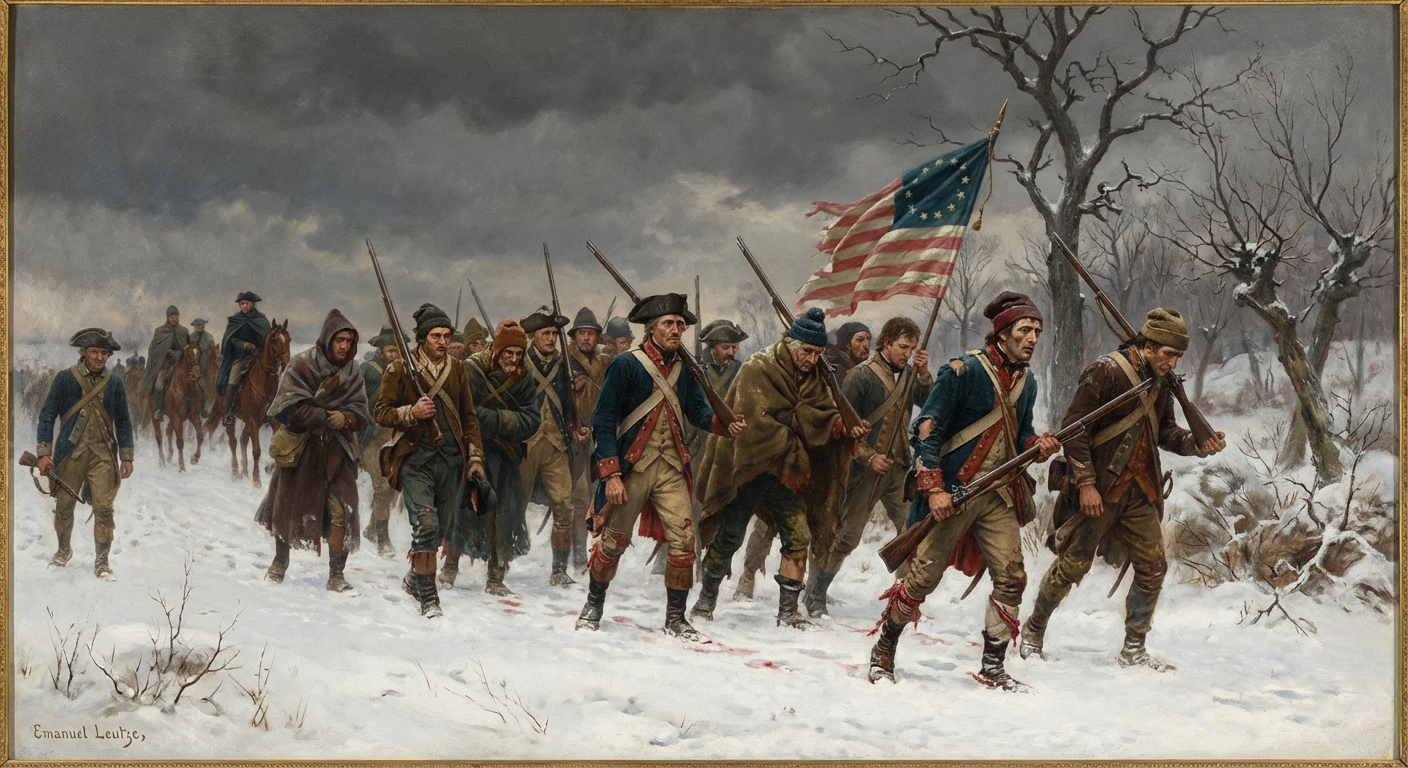
Washington's army was stuck outside Boston without the heavy guns to finish the siege. Knox went north, gathered fifty-nine cannon, mortars, and howitzers, and dragged roughly 119,000 pounds of artillery about 300 miles through winter.

59 artillery piecesabout 119,000 poundsabout 300 milesabout 50 daysBoston forced open

Correction locked in: Knox did not haul the artillery to Washington, D.C. The capital did not exist yet. He hauled it from Fort Ticonderoga / Crown Point through the Lake George, Hudson, Albany, Berkshire, and western Massachusetts route to Cambridge outside Boston, where Washington's army used the guns to force the British evacuation of Boston.

Long-form feature / 20-minute read draft

The Whole Haul

This is now one continuous long-form feature. Use the chapter links as a table of contents, or just keep scrolling through the full route.

Chapter 1 / Siege of Boston

Boston Has No Teeth

The Siege of Boston was a strange kind of victory. The Americans had the British penned inside the town. They had roads watched, approaches covered, and militia camps wrapped around the city from Roxbury to Cambridge. But they did not have the one thing that could turn a siege line into a decision: heavy guns.

By late 1775 George Washington had inherited an army that looked more like a political emergency than a professional force. It had courage. It had local knowledge. It had men who had seen the British bleed at Lexington, Concord, and Bunker Hill. But it was short of powder, short of discipline, short of enlistment time, and almost completely short of siege artillery.

Boston itself sat under British occupation. Royal troops held the town and the harbor. British ships could move in the water, bring supplies, protect the evacuation routes, and punish any obvious American move. The Continentals could make the occupation uncomfortable. They could not yet make it impossible.

That was the problem Henry Knox saw. Knox was twenty-five years old, a Boston bookseller by trade, massive in body, hungry in mind, and obsessed with military science. Before the war he had sold books on artillery, fortification, and European war. Then he read them. Washington noticed. In an army full of men with militia experience, Knox stood out because he had made himself useful in the one branch of war the army most lacked.

Fort Ticonderoga had changed the equation months earlier. In May 1775, Ethan Allen, Benedict Arnold, and their men had surprised the British posts at Ticonderoga and Crown Point. The capture was famous for the boldness of the raid, but its real value sat in the forts afterward: iron and brass guns, mortars, howitzers, shot, lead, and flints. The captured weapons were far from Boston, stranded in the Lake Champlain country. To Washington they were potential. To Knox they were an answer.

Knox proposed the idea plainly enough: go to the forts, choose the usable heavy guns, and drag them to the army outside Boston. It sounded possible only if spoken quickly. The route ran roughly three hundred miles through winter, bad roads, rivers, frozen crossings, steep country, and thinly settled stretches where ox teams and sleds had to be found, hired, fed, replaced, repaired, and pushed onward.

Washington approved the mission in November 1775 and told Knox to spare no trouble or expense. That phrase matters. It was not a ceremonial errand. It was a strategic gamble. If Knox failed, Boston might remain locked in stalemate. If he succeeded, Washington could put guns where British ships and troops could no longer ignore them.

So the story begins with an army that could see its enemy but could not reach him, and with a young artilleryman leaving camp for the north to bring back the weight of a war.

Knox was not one of the fifty-six Declaration signers. His Declaration-era contribution was different: he gave the rebellion the heavy artillery logistics it needed to make independence more than a political claim on paper. He later became Washington's chief of artillery and, after the war, the first U.S. Secretary of War.

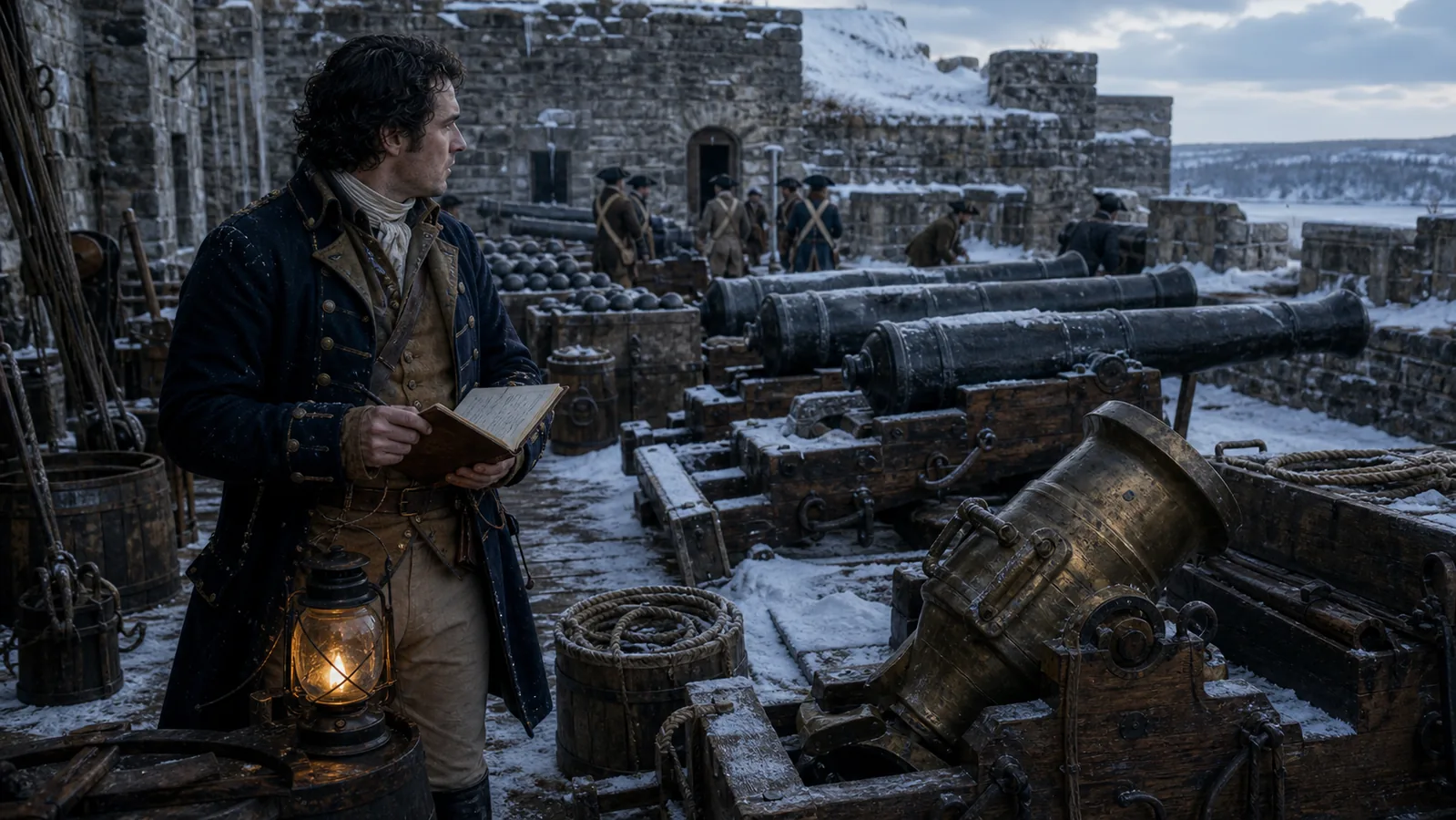
Henry Knox discovering and inventorying captured artillery at Fort Ticonderoga
The discovery. Knox found the war-weight Washington needed: cannon, mortars, howitzers, shot, tackle, and the practical problem of moving all of it.
MissionMove captured heavy artillery from the Lake Champlain forts to Washington's army near Boston.
DistanceAbout 300 miles overall, not a short local haul.
DurationRoughly 50 days from the Ticonderoga work to arrival near Cambridge.
Strategic resultArtillery enabled the Dorchester Heights move that made Boston untenable.

Chapter 2 / Fort Ticonderoga and Lake George

The Guns in the North

Knox did not go to Washington, D.C. That city did not exist. He went to Fort Ticonderoga and the Lake Champlain region, where captured British guns were waiting in winter silence.

Knox reached Ticonderoga in early December. The fort was a prize, but it was not a ready-made delivery warehouse. Guns had to be inventoried, selected, dismounted, prepared, shifted to landings, and loaded. Some were useful. Some were too awkward. Some were too damaged. Knox had to make choices with Boston in mind: what could be moved, what would matter when it arrived, and what was worth risking men and animals to carry.

The final train is usually described as fifty-nine cannon, mortars, howitzers, and related artillery pieces, weighing roughly 119,000 pounds. These were not all the same kind of weapon. Field pieces could move with an army. Siege guns and mortars were slower, heavier, and more punishing to transport, but they could throw weight across distance and make fortifications meaningful. Boston needed that kind of metal.

The first major obstacle was water. Knox had to move the guns through the Lake Champlain and Lake George corridor before the overland sled haul could truly begin. Flat-bottom boats, batteaux, pettyaugres, and scows were the practical answer. The water could carry what roads could not. But winter water was its own enemy.

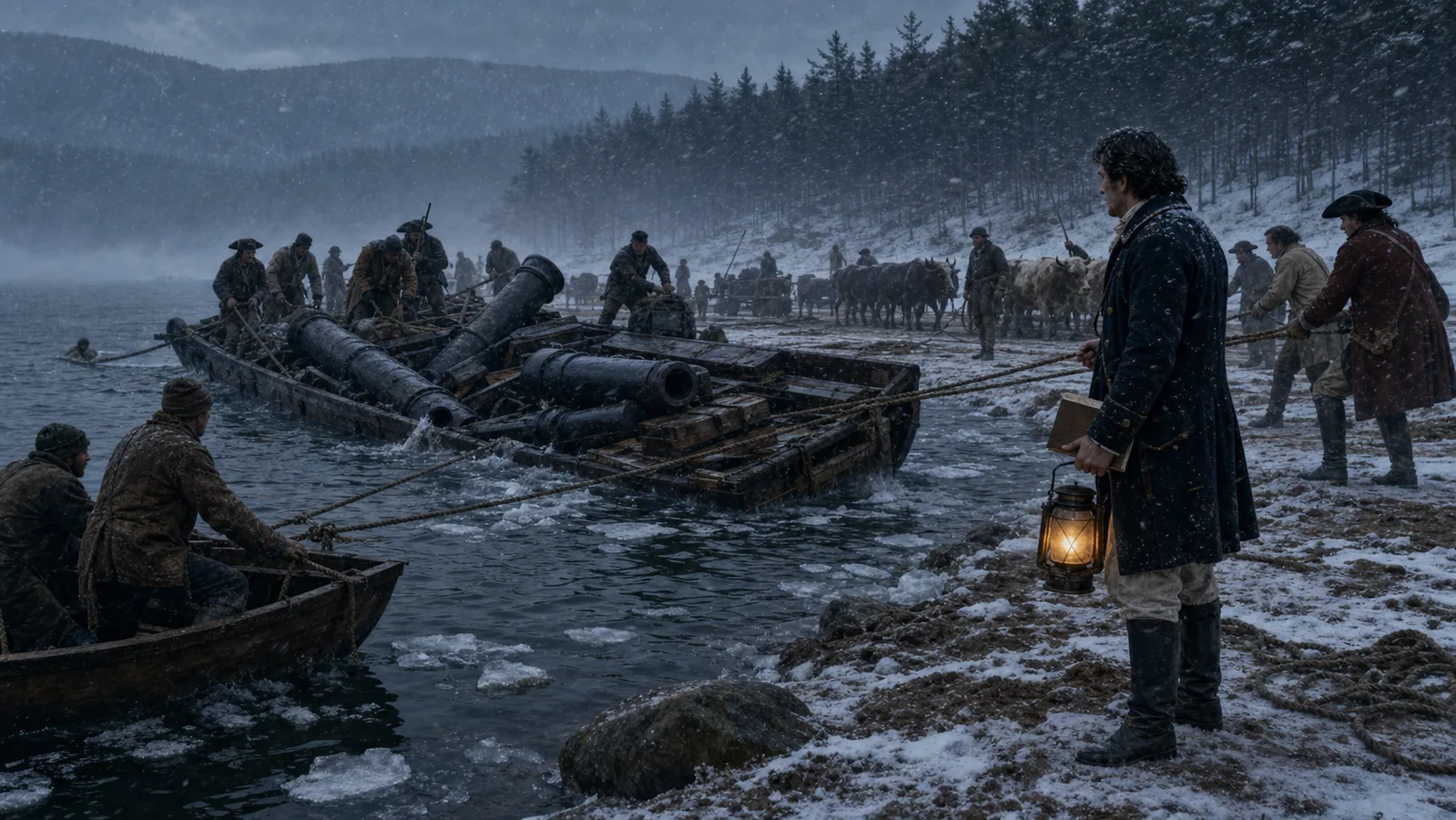
At Lake George, the operation nearly made the whole story a disaster before the sleds had even started. The artillery went onto boats and scows. One large scow carrying artillery became stuck on an underwater rock. Later it foundered and sank. That is the kind of detail that separates the real story from the clean schoolbook version. The noble train was not a smooth parade of cannon across snow. It was a chain of near-failures, recoveries, improvisations, and local fixes.

The lake scene deserves to be lingered on. A flat-bottomed transport craft is not a dramatic warship. It is a practical box for weight. That was exactly why Knox needed it. A cannon that could not be hauled fast over bad roads could be floated, if the lake cooperated. But a scow loaded with artillery has almost no forgiveness. If it grounds, the load cannot simply step out and walk. The craft becomes a problem of leverage, cold water, rope, and men working around metal that can crush them.

When the overloaded craft foundered, the expedition briefly became a salvage operation. The guns had already been won from the British once; now they had to be won back from Lake George. This is the first big visual set piece for the story: the lake surface dark under December weather, men on the shore hauling lines, the heavy gun half-lost, and Knox measuring the delay against Washington's need outside Boston.

The guns were recovered. That sentence is easy to write and hard to picture. Men working in freezing conditions had to deal with a loaded craft, heavy iron, cold water, ropes, leverage, and time pressure. Every hour mattered because the route depended on weather. Too little freeze and the sleds could not cross. Too much thaw and rivers became traps. Knox was racing winter and needing winter at the same time.

From the lake country the artillery had to be staged toward the Hudson Valley. Roads were rough, bridges questionable, and local help indispensable. This is where Knox's strength as an organizer begins to show. He was not simply a bold young officer. He was a coordinator of people: soldiers, teamsters, carpenters, boatmen, farmers, contractors, and local authorities. The guns moved because a network moved.
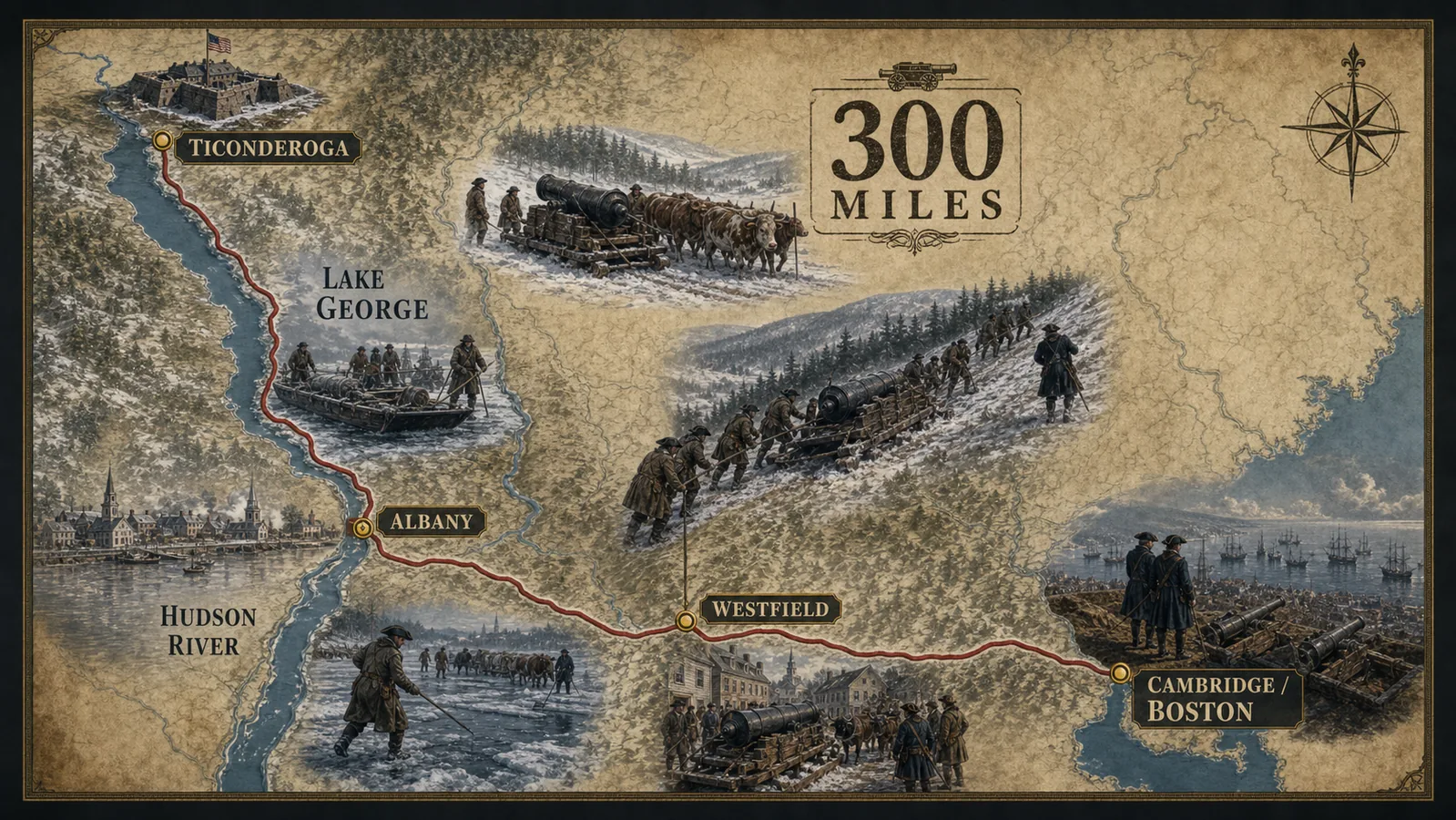
Illustrated route map of Henry Knox Noble Train from Ticonderoga to Cambridge
Route logic. Water first where possible, then sleds, ice crossings, upland roads, Westfield, and the final push toward Cambridge.
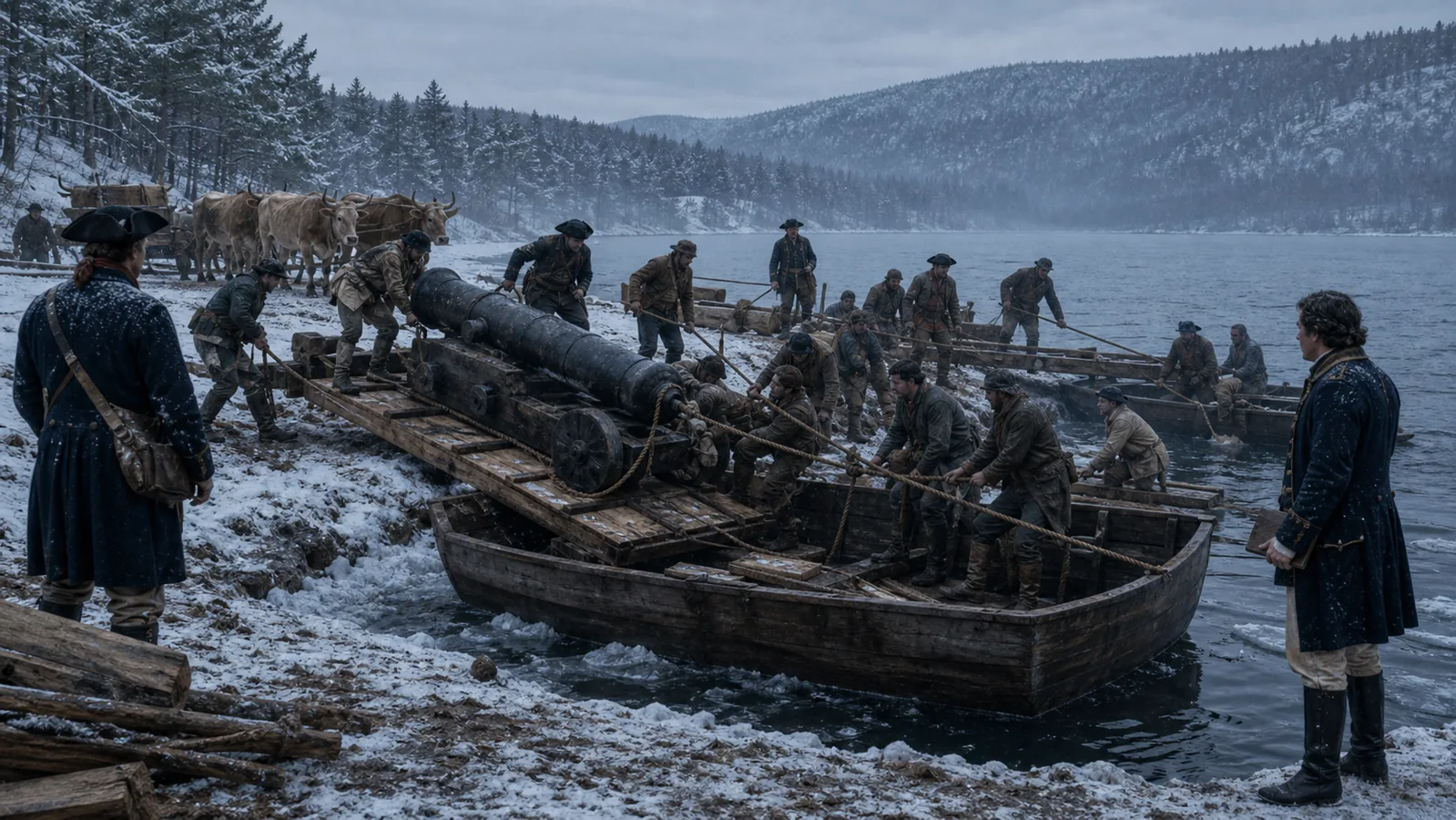
Knox men loading heavy cannon onto flat-bottom scows at Lake George
Loading the scows. Water could carry weight better than winter roads, but only after the guns were wrestled onto flat-bottom craft by rope, tackle, and muscle.
Henry Knox directing recovery of artillery from a foundering Lake George scow
Lake George crossing. One overloaded artillery scow stuck on rock and later foundered; the guns were recovered and the train continued.
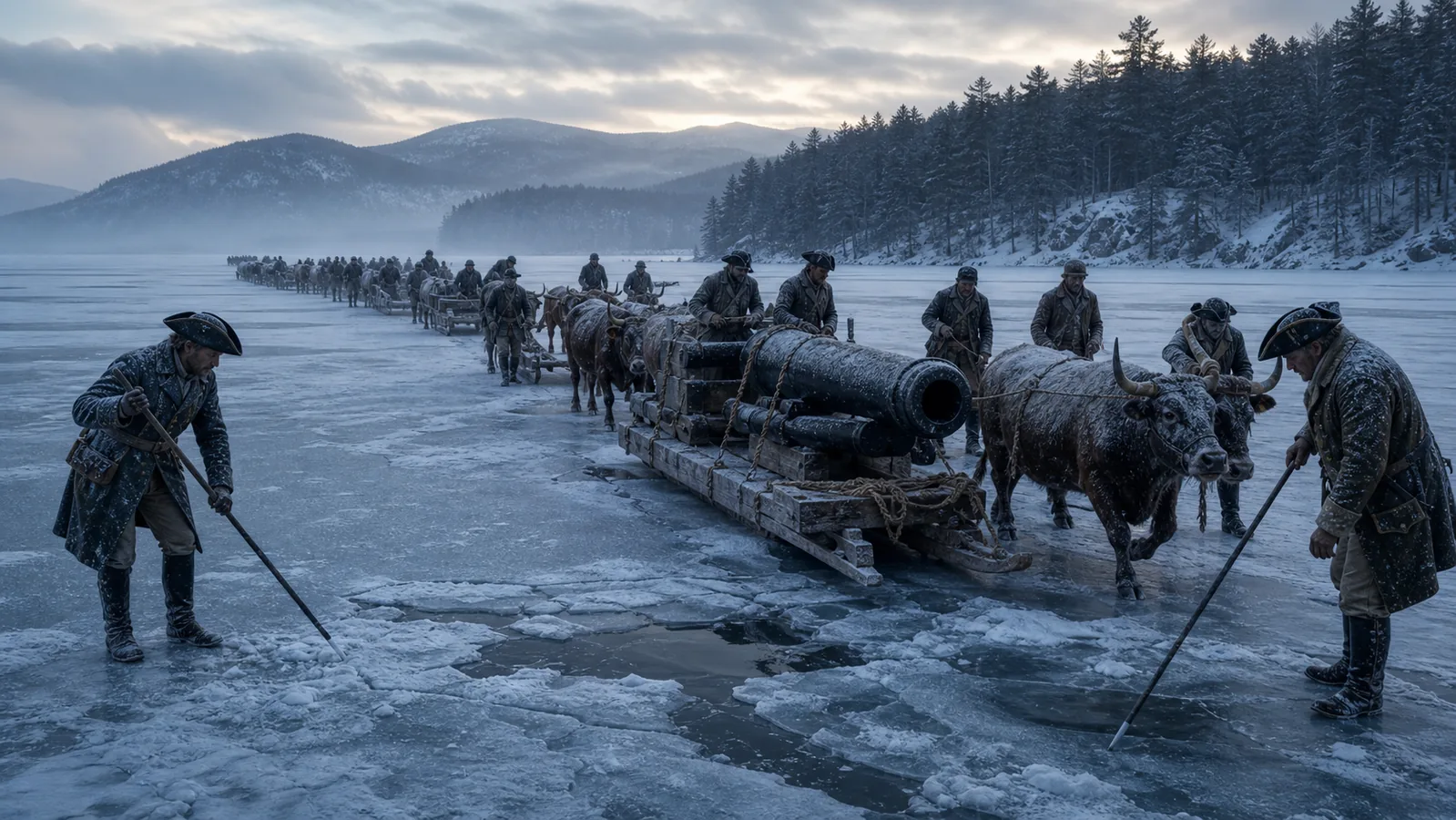
Knox artillery sleds crossing a frozen lake surface
Frozen water as road. The train moved where winter allowed it: cannon sleds, oxen, men testing ice ahead, and every crack threatening the whole operation.

Chapter 3 / Sleds, Oxen, and Local Muscle

Forty-Two Strong Sleds

Knox's famous line to Washington was not poetry. It was a supply report: strong sleds, oxen, and a plan to drag war-weight across winter roads.

William Knox belongs in the story here. Henry's brother helped secure teams, sleds, and the practical means of moving the artillery. That kind of help rarely gets the marble-statue treatment, but without it the mission becomes a young officer staring at a pile of heavy guns with no way to move them.

The figure Knox gave Washington is one of the strongest details in the whole episode: forty-two "exceeding strong" sleds and eighty yoke of oxen. The phrase sounds almost cheerful until you picture the line. Eighty yoke means not eighty animals but pairs of working oxen, a moving chain of muscle, horns, breath, drivers, and creaking harness. It means feed and replacement teams. It means local men who knew their animals and roads better than any officer from headquarters could.

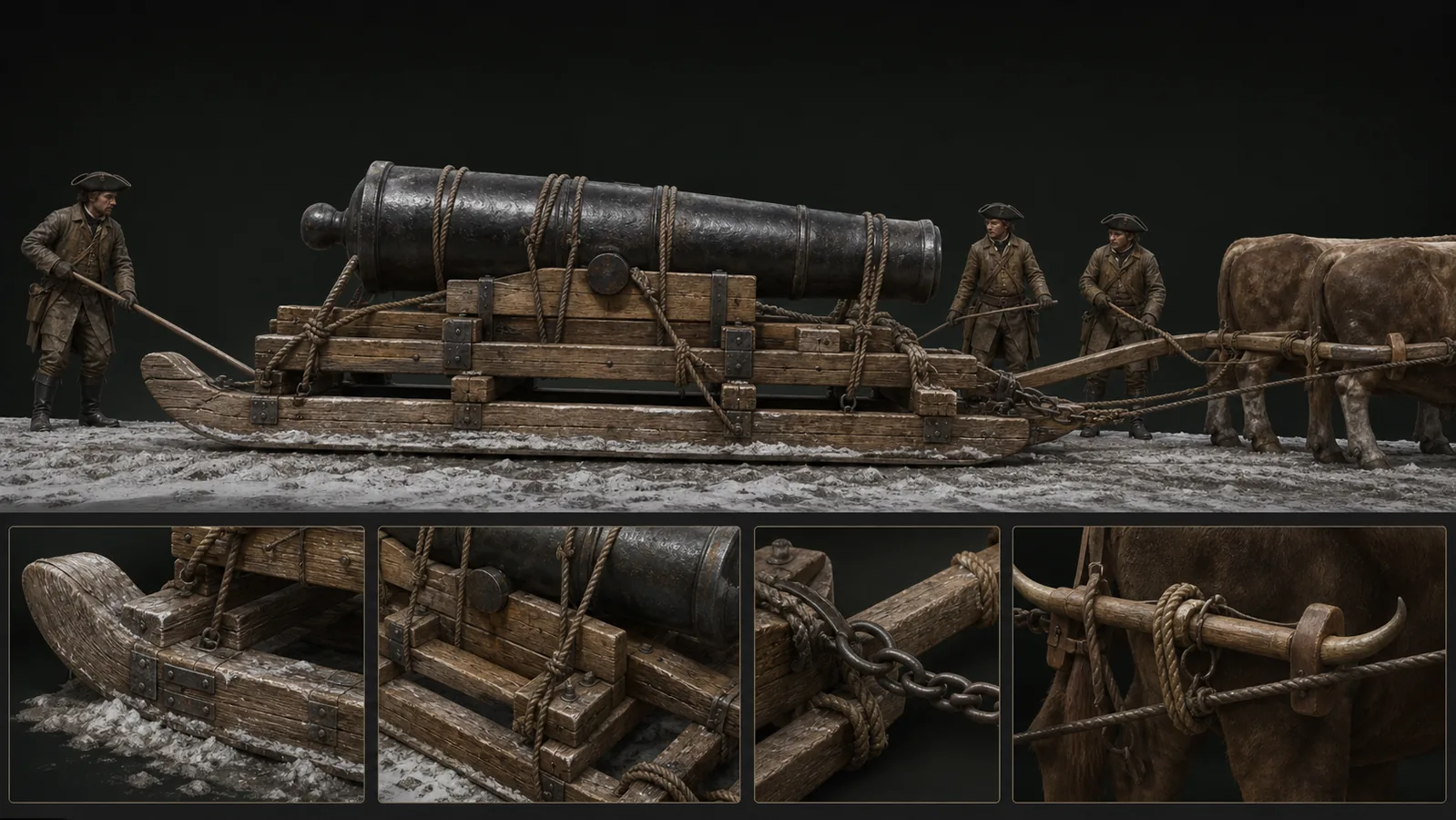
Each sled was a bargain with physics. Too light and it broke. Too heavy and it sank or locked into the road. Too narrow and it tipped. Too wide and it fought the trail. On grades, men had to control the descent so the sled did not overrun the team. On climbs, every foot could become a contest between iron, snow, animal strength, and human will.

A cannon on a sled is not just heavy. It is stubborn. It wants to sink into soft snow, skid on hard ice, twist on uneven ground, break its lashings, crack the sled, or drag the animals sideways on a hill. A good sled had to keep the barrel clear of the ground, distribute weight, and survive repeated shock. When a sled failed, the entire line behind it could stall.

Oxen were the right power for much of the job. They were slower than horses but stronger under drag, steadier in poor footing, and familiar to local farmers. But oxen were not machines. They tired. They needed feed. They needed drivers. They needed replacement teams. The further the train moved from one settled area to the next, the more Knox had to negotiate the next day's horsepower before the previous day's work was finished.

That is why the term "train" matters. It was not one cart. It was a moving system: teams, sleds, spare gear, men walking beside the guns, officers pushing schedules, locals opening routes, ferrymen and carpenters solving problems, and the guns themselves, each one a dead weight until human organization made it move.

The weather, perversely, could be both ally and enemy. Snow made sleds useful. Deep snow made travel exhausting. Ice made rivers crossable. Weak ice killed momentum and threatened to swallow the mission. A thaw could turn roads into mud and make ox teams useless. A hard freeze could save the train and endanger the men.

Knox's optimism was real. He hoped to present Washington with the noble train quickly. The route took longer. The delay was not failure. It was the price of moving siege artillery through a winter landscape that had never been designed to move siege artillery at all.

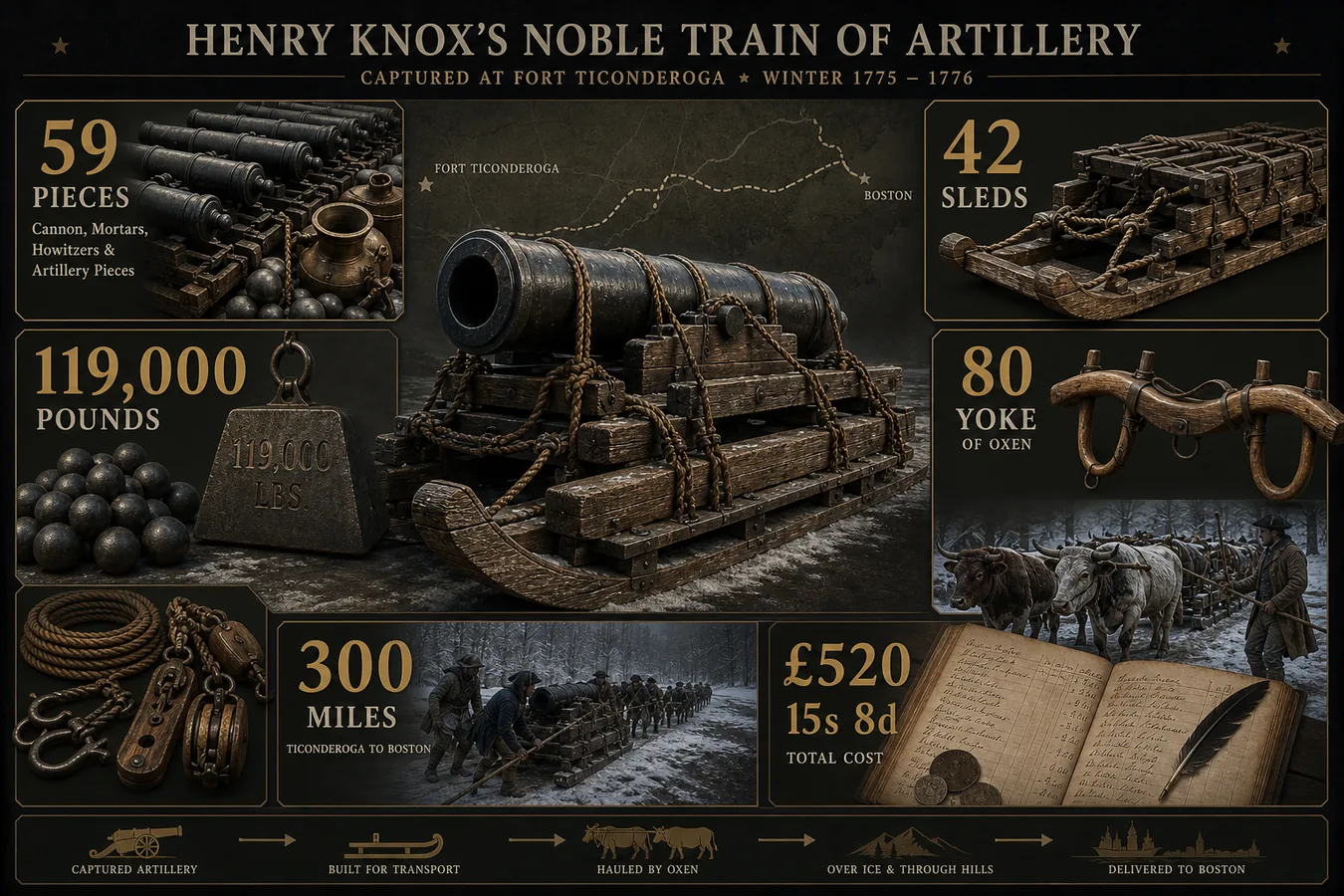
Inventory breakdown of Knox artillery, sleds, oxen, route distance, and cost
Numbers with weight. Fifty-nine pieces, roughly 119,000 pounds, forty-two sleds, about eighty yoke of oxen, three hundred miles, and the expense account behind the legend.
Technical view of Henry Knox artillery sled system
Sled geometry. The train worked because load, traction, animal power, braking ropes, runners, and road conditions were managed together.

Chapter 4 / Albany and the Hudson

The River That Had to Become a Road

The Hudson crossings are the terror scenes: ice tested by weight, holes cut to flood and thicken the surface, sleds breaking through, and cannon hauled back from the river.

At Half Moon, near the junction country where the Mohawk meets the Hudson, the journey produced one of its sharpest disasters. A sled carrying a heavy gun went through the ice. Knox's own journal tradition remembers the ice breaking wide around it. A cannon in a river is not just a lost weapon. It is a dead stop. The team has to be saved, the ropes controlled, the remaining sleds kept moving or held back, and the gun recovered before weather turns the whole crossing worse.

The people of Albany matter because they made that recovery possible. They turned out in the cold, helped haul the gun back from the river, and became part of the train's memory. Knox's gratitude was not abstract. He reportedly christened one recovered piece "The Albany." That name gives the local effort a kind of permanent place in the story: a cannon named not for a general, but for the town that helped save it.

The Hudson was crossed again and again in this phase, often summarized as four crossings. That repetition is important. A single successful crossing might be luck. Four crossings with heavy artillery means a continuing contest with the river. It also means the train's danger did not peak once and vanish. The men had to face the same kind of fear repeatedly.

Albany was not just a town on the route. It was a hinge. The artillery had to cross the Hudson River multiple times in the broader Hudson Valley movement, often described in the tradition as four crossings. Each crossing turned the problem from transportation into faith: faith in ice, ropes, animal footing, and the judgment of men who had to decide whether sixty tons of artillery could move where water was waiting underneath.

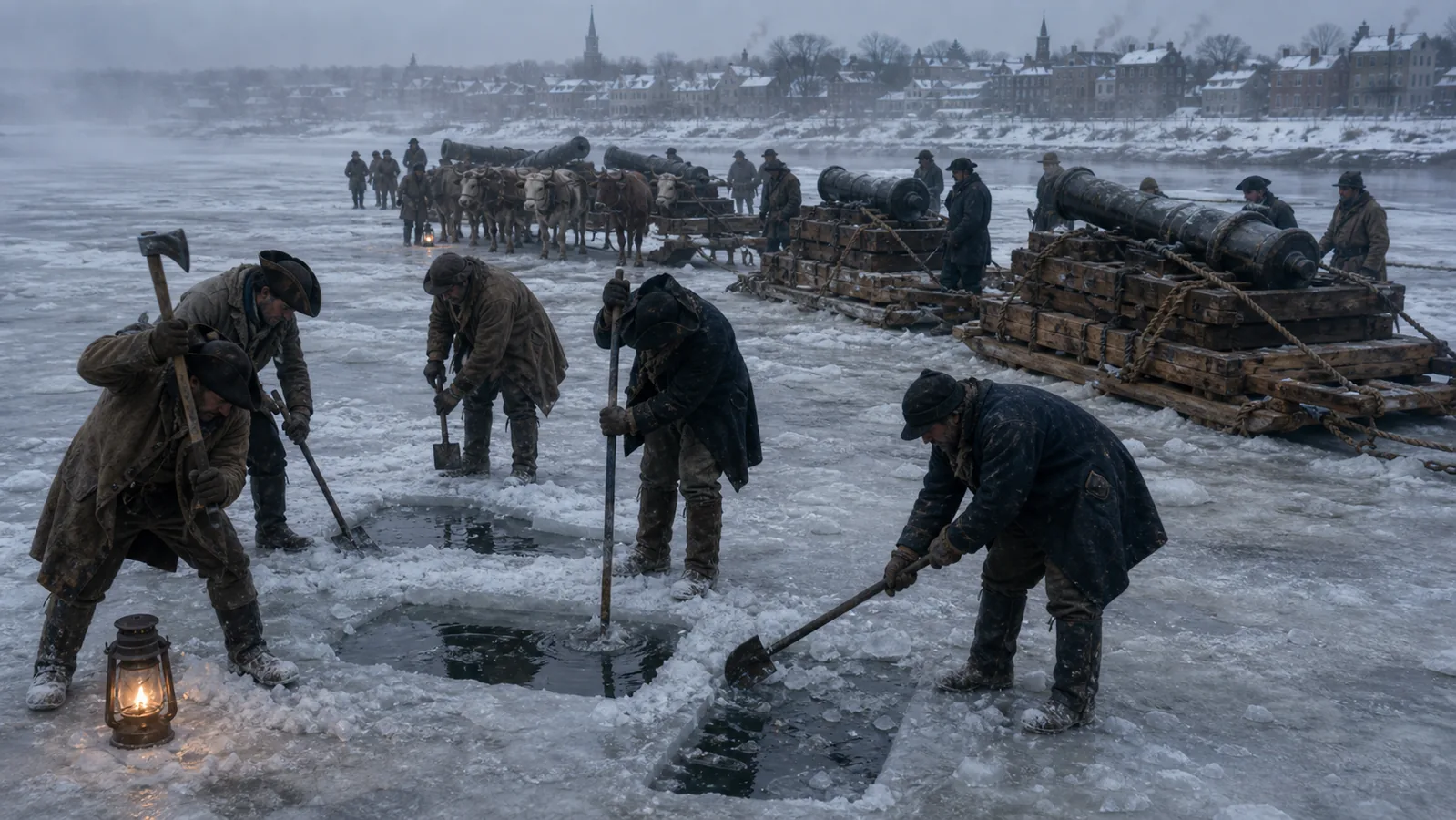
At Albany, the solution was almost brutal in its simplicity. Men cut holes in the ice so water would flood the surface. Then they waited for that water to refreeze, thickening the ice road. It sounds clever because it was. It also sounds terrifying because it was. They were deliberately putting water on the road they needed in order to make that road stronger.

The operation still went wrong. Around the Albany / Half Moon area, at least one sled broke through the ice and a cannon went into the river. This is one of the great visual moments of the story: oxen straining, men shouting, ropes going tight, ice breaking black under a gun that had already survived the fort, the lake, the road, and the scow.

That matters for how we tell the story. Knox was the name on the mission, and he earned it. But the noble train was a public work of war. It depended on teamsters, boatmen, farmers, smiths, laborers, and townspeople who understood that a cannon at the bottom of a frozen river was not just a lost object. It was a lost chance at Boston.

Once the Hudson was behind them, the train still had to climb and cross into Massachusetts. The Berkshires were waiting. The guns had survived water; now they had to survive elevation, weather, and the final exhaustion of a winter haul.

Men cutting holes in Hudson River ice near Albany to thicken the crossing
Ice engineering. At Albany, men cut holes so water would flood and refreeze, thickening the surface for the cannon sleds.
Cannon sled breaking through Hudson River ice near Half Moon
Half Moon disaster. At least one sled broke through the ice and a cannon went into the river before locals and soldiers hauled it out.

"The important thing is not that nothing went wrong. Almost everything that could go wrong eventually tried. The important thing is that the train kept recovering."

Chapter 5 / Cambridge, Dorchester Heights, Evacuation

The Guns Arrive

Knox arrived near Cambridge in January 1776. The guns did not end the siege immediately, but they gave Washington the missing tool for the move that would.

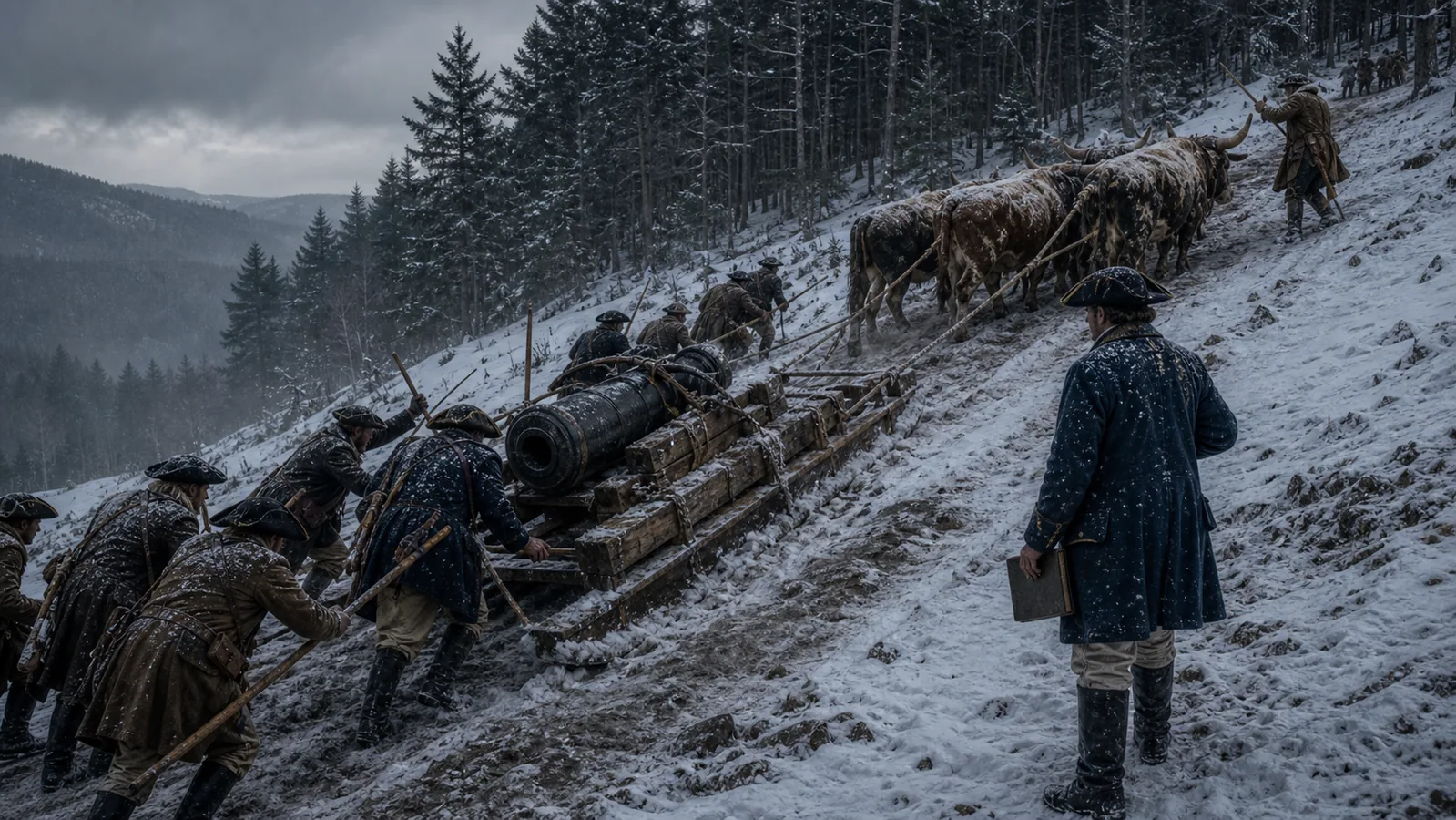
Before the train reached Cambridge, it had to cross the Berkshires. Knox's own language makes this part feel almost unreal. From the high country he wrote of mountains from which a man might almost see all the kingdoms of the earth. Near Blandford he marveled that people with heavy loads could get up and down such hills at all. This was not the flat final stretch of a completed errand. It was another ordeal after the water, the ice, and the river.

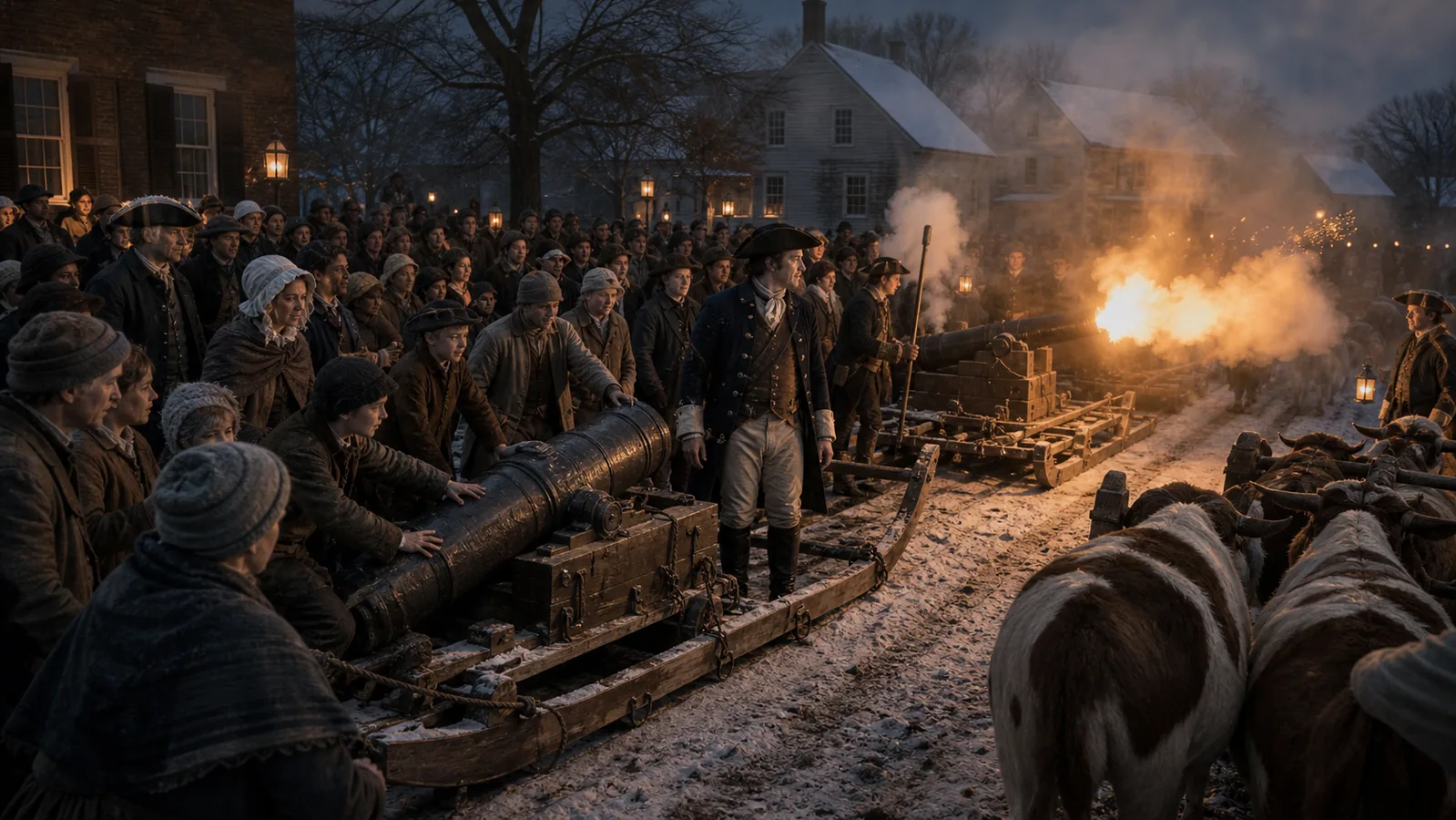
At Westfield, the train became public theater. Townspeople turned out to see the guns. Some came close enough to touch them. Think about what that meant. These were not ordinary freight pieces. They were captured British cannon, dragged through winter, now passing through a Massachusetts town on the way to Washington's army. Knox gave the crowd a treat: one cannon was fired. For a moment the long silent haul spoke out loud.

The artillery reached Cambridge in January 1776 after about fifty days on the road. Knox had moved roughly sixty tons of artillery over about three hundred miles at a recorded cost usually given as £520 15s 8d. That last figure is useful because it pulls the legend back to earth. This was inspiration, but it was also an expense account.

The arrival of the artillery changed the strategic language outside Boston. For months Washington's army had been threatening with presence. Now it could threaten with range. The guns could be placed to cover approaches, support batteries, and make high ground matter.

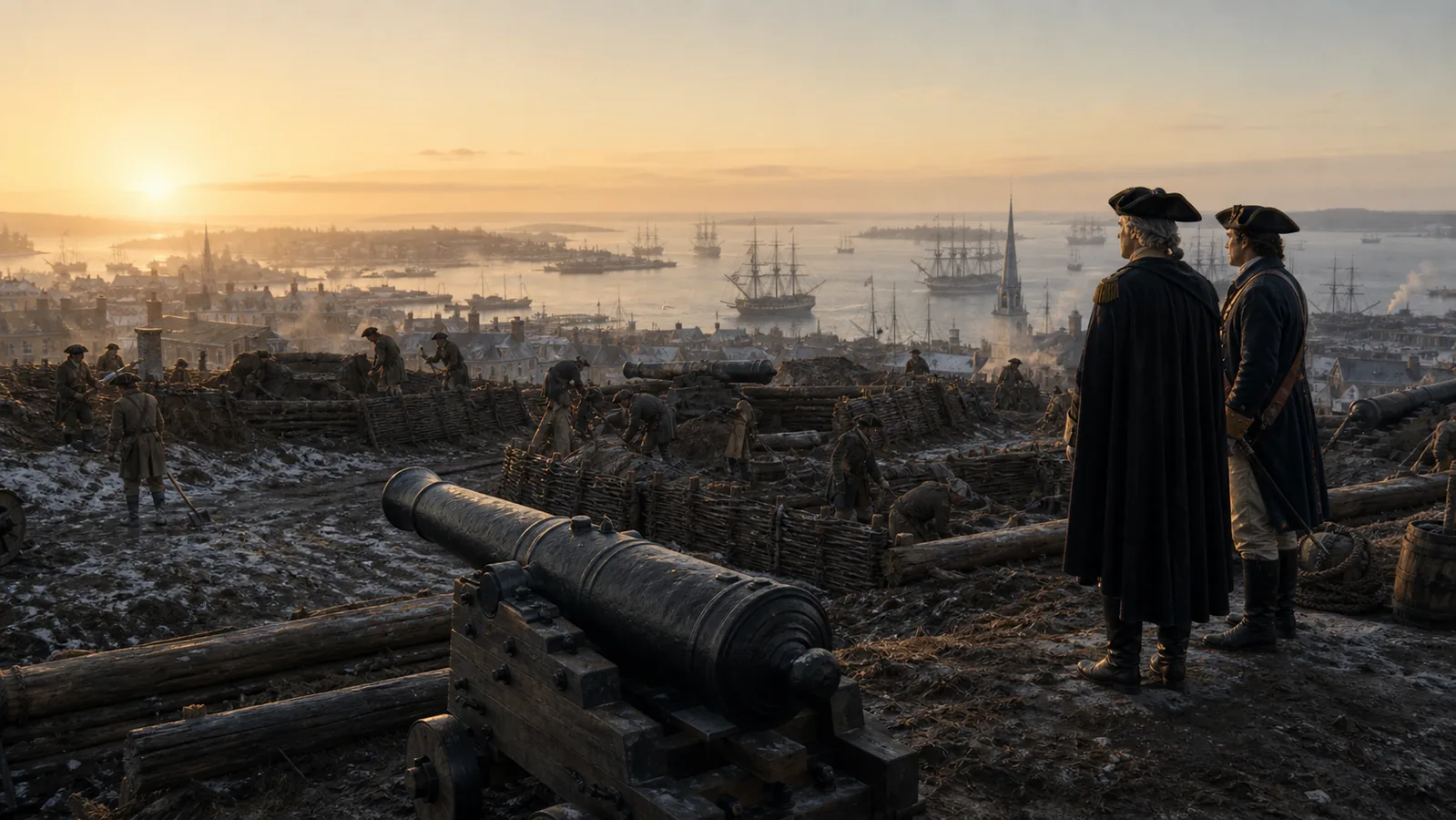
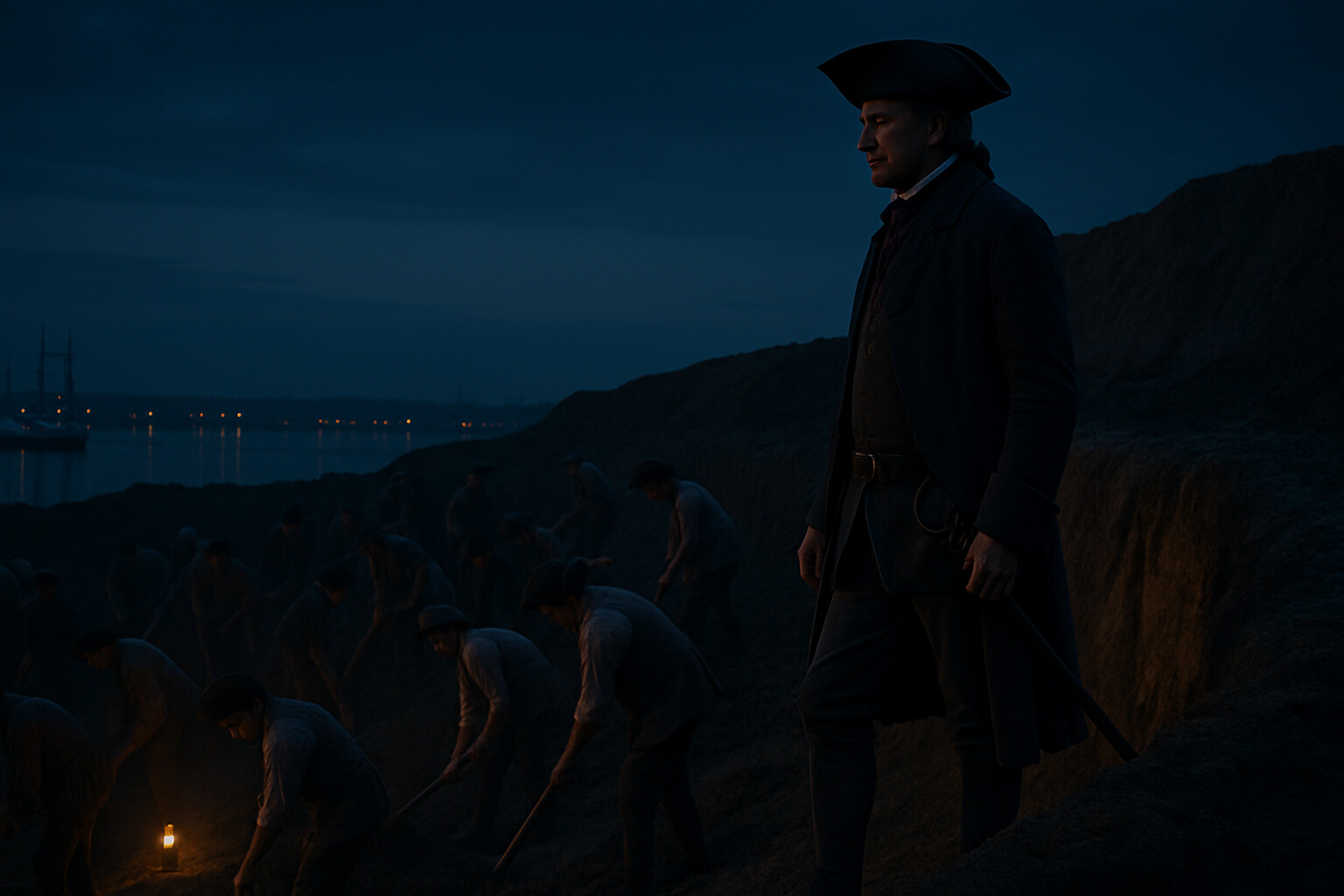
The decisive move came in March. Washington used bombardments to distract and pressure the British while American troops prepared to fortify Dorchester Heights. On the night of March 4, 1776, the Americans moved onto the heights and worked with astonishing speed. By morning, British officers looking up from Boston saw fortifications and guns where the night before there had been open ground.

Dorchester Heights commanded Boston and the harbor. With artillery there, British ships and troops were vulnerable. General William Howe faced the problem Washington had been trying to create since Knox left for the north: Boston could no longer be held comfortably by sea power alone. The position had changed from occupied town to exposed trap.

The British considered attacking the heights, but weather and the strength of the American position worked against it. Instead, they prepared to leave. On March 17, 1776, British forces evacuated Boston. The Continental Army had forced the evacuation of a major city without storming it.

That is the payoff of the noble train. The guns did not win a glamorous battlefield charge. They made a position impossible. They turned geography into leverage. They converted a winter logistics operation into a strategic victory.

Henry Knox would go on to become Washington's chief of artillery and later the first Secretary of War under the Constitution. But the legend begins here: a former bookseller sent north for captured cannon and returning with the weight that helped push an empire out of Boston.

It is one of the best American Revolution stories because it is not simply about bravery. It is about competence under pressure. It is about knowing what the army lacks, finding it hundreds of miles away, moving it through every kind of failure, and arriving in time for history to turn.

Knox artillery train hauling a cannon sled up a brutal Berkshire hill
Berkshire ordeal. Even after Albany, the route still had hills Knox described as almost miraculous for heavy loads to climb and descend.
Westfield residents gather to touch Knox cannon as one is fired
Westfield spectacle. Townspeople came out to see and touch the captured guns; Knox gave them a show by having one cannon fired.
Artillery on Dorchester Heights threatening Boston Harbor
The strategic reveal. The guns on Dorchester Heights made the British position in Boston and the harbor vulnerable.
Why it matteredThe first major American strategic victory came from logistics, artillery science, local labor, and the final occupation of high ground.
Video angleThe best clip is not a battle charge. It is a cannon sled breaking through Hudson ice, then cutting to Dorchester Heights at dawn.

Operational read

Why the Noble Train Worked

The obvious way to tell the story is to say that Knox dragged cannon through snow. That is true, but it is not enough. The more useful way to understand the noble train is as an early American logistics operation that succeeded because it broke a huge problem into smaller moving problems.

First came selection. Knox did not need every piece of metal in the captured forts. He needed guns that were worth the pain of moving. That meant thinking like an artillery officer before the first sled moved. A barrel too damaged to trust, a piece too awkward to justify, or a load that could not survive the route could slow everything behind it. The decision of what not to bring mattered almost as much as what to bring.

Second came staging. Water, when it could be used, carried weight better than roads. That is why the Lake Champlain and Lake George phase matters so much. The guns had to be shifted from fort to boat, boat to shore, shore to sled, sled to road, road to ferry or ice crossing, and then back to road again. Every transfer was a chance to lose time or lose a gun.

Third came local contracting. Knox's mission depended on people who were not famous: men who owned oxen, men who knew which roads held snow, men who could build or repair sleds, men who could judge river ice, men who could lend tackle, rope, boards, ironwork, feed, and labor. The Revolution often gets told through generals and declarations. The noble train shows the war being won by local capacity.

Fourth came morale. A cold army can still march if it believes the work matters. A teamster can keep going if the officer in charge knows the route, pays attention, and solves the next problem instead of merely shouting at it. Knox's letters show impatience and confidence together. He wanted the guns moving faster, but he also understood that each delay had to be answered practically.

Finally came timing. Washington did not need artillery in the abstract. He needed enough artillery in time to change the siege before the army dissolved, before British options improved, and before the war settled into a shape the Americans could not control. Knox delivered the tools for a move Washington could actually use.

SelectionPick artillery worth moving, not every captured piece.
StagingUse water, sleds, roads, ferries, and ice where each made sense.
Local helpOx teams, sleds, rope, repairs, food, and labor came from communities along the route.
Strategic timingThe guns mattered because they arrived before Washington's Boston position lost momentum.

Chronology

The Road in Sequence

November 1775: Washington authorizes Knox to go north and bring back the artillery from the captured Lake Champlain posts. The decision is bold because it assumes the army can solve a transportation problem that would intimidate a better supplied force.

Early December: Knox reaches the Ticonderoga region and begins selecting, preparing, and moving the guns. The work is physical and administrative at the same time. Guns must be handled safely, listed, loaded, and guarded; people and equipment have to be found before the weather closes or breaks the route.

Lake George phase: The train uses boats and scows to carry weight over water. The foundering scow is the warning sign that the mission will not proceed like a neat march. Every part of the route can produce its own emergency.

Sled phase: The guns move by snow road on heavy sleds. Knox's forty-two sleds and the often-cited eighty yoke of oxen become the visual center of the story: animals bent into harness, barrels lashed down, drivers walking beside them, men prying and pushing when the road rises or fails.

Hudson crossings: The river becomes the most dramatic test. The ice is not simply trusted; it is worked. Holes are cut, water floods the surface, and the refreeze is used to strengthen the road. Even then, at least one cannon breaks through and must be recovered.

Massachusetts approach: The train climbs eastward and closes on Cambridge. By this point the story has become a test of endurance. Each recovered gun carries not just metal weight but accumulated time, risk, and human labor.

January 1776: Knox reaches Washington's army with the artillery. The guns are not instantly decisive, but they give Washington the missing capability he has needed since the siege began.

March 1776: Washington's army fortifies Dorchester Heights. The British wake to see artillery and works in a position that threatens Boston and the harbor. The guns Knox moved now speak without needing to fire a decisive battle. Their presence changes the British calculation.

March 17, 1776: British forces evacuate Boston. Evacuation Day becomes the visible victory, but the hidden victory was the winter system that put the guns within reach.

Image and video prompt pack

Graphics to Generate Next

The live page already has custom technical SVGs. These prompts are for photorealistic stills and animation sources to upgrade it further.

Westfield public cannon firing

Photorealistic Revolutionary War winter scene in Westfield Massachusetts, townspeople gathered around Henry Knox's captured cannon train, men and women reaching to touch a massive cannon on a wooden sled, Continental artillerymen preparing to fire one cannon as a public demonstration, ox teams nearby, snow on the ground, 1776 clothing, warm town lanterns, no modern objects, no readable text, 16:9.

Berkshire mountain haul

Photorealistic cinematic winter scene of Henry Knox's Noble Train climbing a brutal Berkshire hill near Blandford, heavy cannon sleds pulled by oxen, men pushing with poles, snow and icy grade, exhausted teamsters, pine forest and steep road, realistic Revolutionary War logistics, no battle, no modern objects, no readable text, 16:9.

Hero still

Photorealistic cinematic historical scene, winter 1775, Henry Knox's Noble Train of Artillery moving through a snowy New England road at dusk, massive brass and iron cannon lashed to wooden sleds, ox teams straining, Continental soldiers in worn coats with lanterns, breath visible, deep wagon ruts, dark pine forest, period accurate Revolutionary War clothing, no modern objects, no readable text, 16:9, dramatic but realistic.

Lake George recovery

Cinematic photorealistic scene on Lake George in December 1775, flat-bottom artillery scow stuck on an underwater rock and partly foundering, men with ropes and poles recovering heavy cannon, freezing water, ice on shoreline, Fort Ticonderoga expedition atmosphere, urgent logistics not battle, period correct boats and clothing, no readable text, 16:9.

Hudson ice disaster

Photorealistic Revolutionary War winter scene at the Hudson River near Albany, one heavy cannon sled breaking through black ice while oxen and teamsters strain on ropes, townspeople and Continental soldiers helping recover the gun, snow, lanterns, cracked ice, terrifying weight and cold, historically grounded, no modern objects, no readable text, 16:9.

Route map graphic

Museum-quality illustrated map of Henry Knox's Noble Train of Artillery route from Fort Ticonderoga and Crown Point through Lake George, Albany, the Hudson Valley, the Berkshires, and Cambridge near Boston, aged parchment plus dark Front Line Stories styling, clear route line, space for labels to be added later, no baked-in readable text if possible, 16:9.

Dorchester Heights reveal

Photorealistic dawn scene March 5 1776 from Dorchester Heights overlooking Boston Harbor, newly built American earthworks and heavy cannon aimed toward British ships, Continental soldiers exhausted after night labor, Boston town and masts below in cold morning haze, strategic tension, no firing, no modern objects, no readable text, 16:9.

Video prompt

Use the Hudson ice disaster still as the source image. Create a 10-second cinematic historical video: slow push-in across cracked Hudson River ice, oxen straining, ropes tightening, men shouting silently in freezing breath, a cannon sled partly breaking through black water, lantern light flickering, snow blowing sideways. Keep it realistic and grounded, no fantasy, no gore, no modern objects, no text. End with the gun starting to rise from the ice as the crowd pulls together.

Source baseline

Sources Used